

To calculate a SaaS break-even point in customers, divide fixed costs for a period by the contribution each customer generates in that same period. For a simple monthly subscription model:
Break-even customers = monthly fixed costs ÷ (monthly price per customer − monthly variable cost per customer).
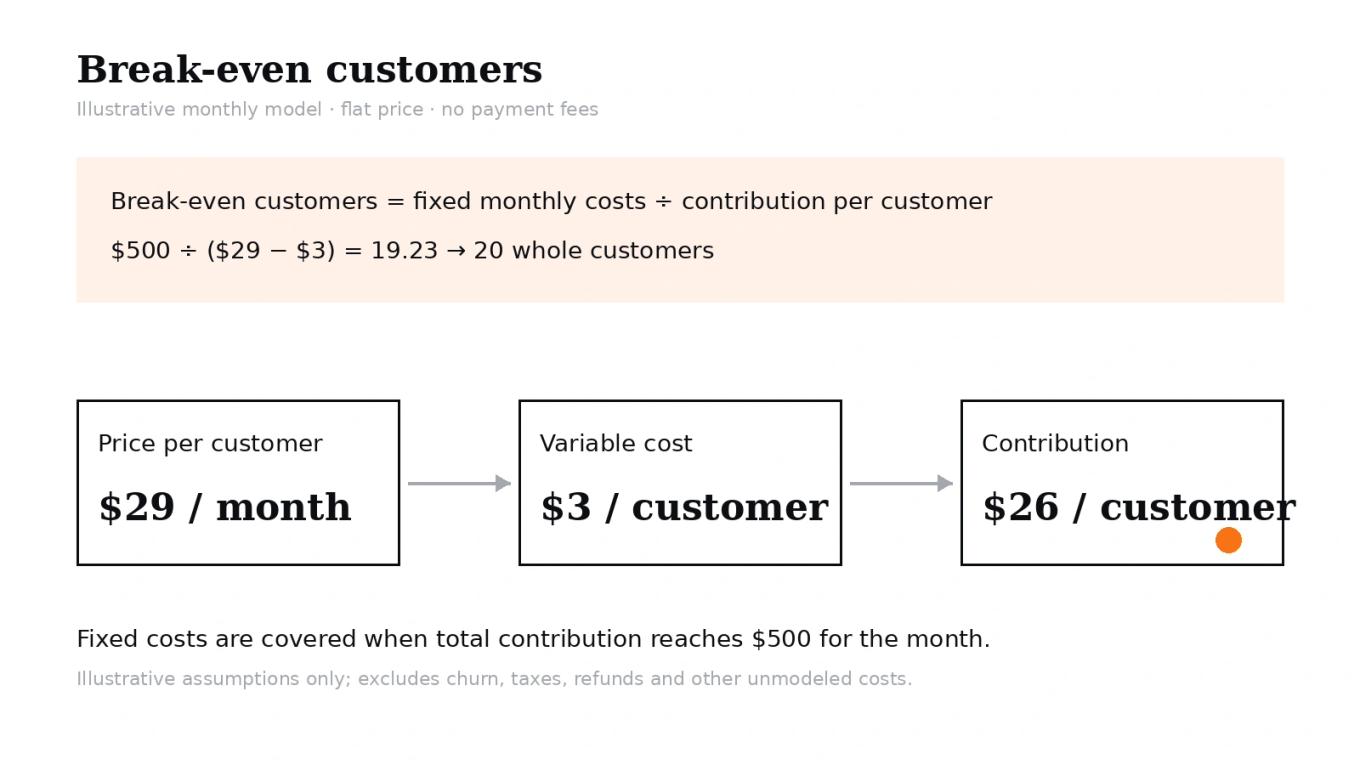
If fixed costs are $500 per month, price is $29 per customer per month, and variable cost is $3 per customer per month, the contribution is $26. The calculation is $500 ÷ $26 = 19.23, so the business needs 20 whole customers to cover the modeled costs. This is a simplified operating model, not a forecast of growth or a guarantee of profitability.
What the break-even point tells you#
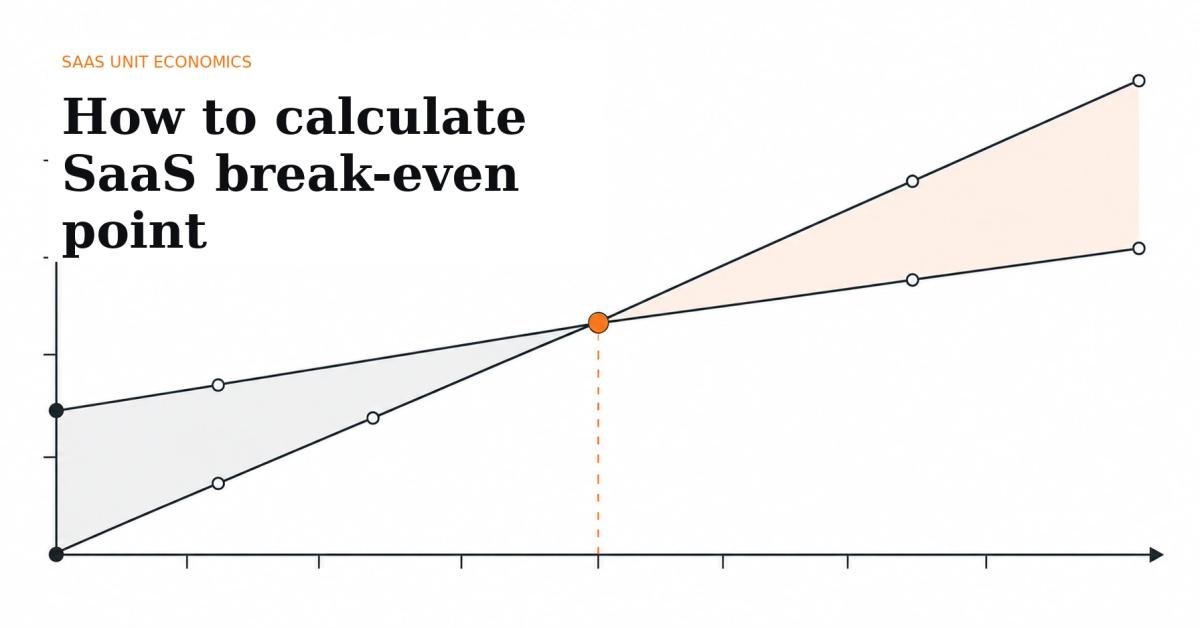
Break-even is the point at which modeled revenue equals modeled costs for a defined period. At that point, the model's profit is zero. Below it, the modeled costs exceed revenue; above it, each additional customer adds their contribution, provided the assumptions continue to hold.
The standard unit formula is fixed costs divided by contribution margin per unit. AccountingCoach explains this relationship and notes that a simple formula becomes less reliable when a business sells products with different contribution margins. For SaaS, the “unit” must be defined carefully: it could be a customer-month, seat-month, or another billing unit.
Define the period and unit first#
Keep the period consistent. Monthly fixed costs must be divided by monthly contribution per customer; annual costs and annual contribution can be used together for an annual model. Do not divide monthly fixed costs by annual customer contribution or compare a one-time setup cost with a recurring month without adjusting the model.
For a flat monthly plan, the unit is one paying customer for one month. For a per-seat plan, the number of seats matters. For usage-based pricing, the contribution depends on the included amount, overage usage, and cost assumptions. If customers have materially different usage patterns, one average contribution can hide unprofitable segments.
Classify fixed and variable costs#
The formula depends on how costs change with activity. Classify costs according to the model you are building, and document the choice rather than assuming every SaaS company should classify an expense the same way.
- Fixed costs for this scenario: costs treated as unchanged over the modeled customer range, such as a fixed monthly software subscription or a fixed operating expense.
- Variable costs per customer: costs assumed to increase with each additional customer, such as customer-specific API consumption or a per-customer service charge when those costs actually vary with use.
- Mixed or step costs: costs that stay flat within a capacity range and then rise, such as infrastructure that requires another tier after a threshold. A single fixed/variable split may not represent these well.
- Allocated costs: shared costs assigned to a customer or plan for analysis. An allocation is a modeling choice; it does not necessarily mean the cost would disappear if that customer left.
Payment processing can be modeled as a variable cost when fees apply to each charge. If the fee includes both a percentage and a fixed amount per transaction, account for the transaction cadence: an annual charge and twelve monthly charges can produce different fixed-fee totals even if the nominal subscription value is the same.
Work through an illustrative example#
Assume a single flat plan with the following inputs. These values are illustrative, not industry benchmarks.
| Input | Assumption | Treatment |
|---|---|---|
| Monthly price | $29 per customer | Revenue per customer-month |
| Variable cost | $3 per customer-month | Variable cost |
| Fixed operating costs | $500 per month | Fixed for this scenario |
| Payment fees | $0 entered | Excluded from this example |
First, calculate contribution per customer:
Contribution per customer = $29 − $3 = $26.
Next, calculate the unrounded break-even customer count:
Break-even customers = $500 ÷ $26 = 19.23.
Because customers are whole units, round up to 20. At 20 customers, monthly revenue is 20 × $29 = $580. Variable costs are 20 × $3 = $60. Contribution is $580 − $60 = $520. After $500 of fixed costs, the modeled remainder is $20. At 19 customers, contribution is 19 × $26 = $494, leaving a $6 shortfall against fixed costs.
The result changes if you enter payment fees, increase usage costs, change the price, or add costs to the model. The arithmetic is exact for the stated assumptions; the assumptions are not a prediction of actual results.
Use the SaaS Pricing Calculator for your scenario#
The SaaS Pricing Calculator lets you enter a plan price, customer count, fixed costs, variable costs, and optional payment-fee assumptions. It supports flat, per-seat, and usage-based pricing, and displays modeled revenue, gross profit, gross margin, net profit after fixed costs, and break-even customers. Use your own billing unit and costs rather than treating the illustrative values above as defaults for your business.
The calculator's documented assumptions include steady-state average usage and annual billing represented as a monthly equivalent. Its indexed limitations exclude churn, taxes and VAT, refunds, free plans and trials, sales commissions, and revenue-recognition timing. It is therefore a scenario calculator, not a forecast, accounting statement, or financial advice.
Where the formula can mislead#
A break-even count is useful only when the model represents the decision you need to make. Review these limits before relying on it:
- Customer mix: different plans, seat counts, discounts, and usage levels may have different contributions. A single average is valid only as a deliberate approximation.
- Capacity thresholds: a new infrastructure tier or support hire can create step costs that are not captured by a constant fixed-cost input.
- Customer acquisition: the basic formula does not account for the timing or cost of acquiring customers unless those costs are explicitly included in the chosen cost model.
- Retention and expansion: churn, upgrades, downgrades, and expansion change the customer base and revenue over time. A steady-state break-even calculation does not predict those changes.
- Cash and accounting timing: revenue recognition, collection timing, refunds, tax treatment, and working capital may differ from this simplified model.
If contribution per customer is zero or negative, increasing customer count does not cover the fixed costs under this formula. Revisit the price, variable-cost assumptions, or pricing unit rather than interpreting the result as a very large but achievable customer target.
References#
- What Is the Break-Even Formula? — AccountingCoach
- Break-Even Point: Formula and Examples — Stripe
- SaaS Pricing Calculator — Letinix

Software Engineer and Researcher, writing about AI, developer tooling and automation.