

Every software product needs user interviews, but only for one job: understanding the problem. Users are the experts on what hurts, how often it hurts and what they do about it today. They are not the experts on what you should build. When you ask them for features, you get a list of guesses, and building that list tends to make the product worse.
The opposite mistake is just as expensive. If you take users out of the process completely, you end up building the product you like, and there is no guarantee anyone else wants it.
TL;DR: Talk to users before, during and after you build. Ask about real past events, pain, workarounds and priorities. Don't ask what features they want or whether they would use your idea. Treat every interview like a bug report: you are collecting reproduction steps, not a patch.
Why a feature request is a poor spec#
A feature request is a user's guess at a fix for a problem you haven't seen yet. It may be a good guess. More often it is shaped by the tools they already know, the last product they used, or whatever sounded reasonable during the call.
Usability research has warned about this for a long time. Jakob Nielsen's First Rule of Usability? Don't Listen to Users (Nielsen Norman Group, August 2001) argues that what users say they want is unreliable, and that you learn more by watching what they actually do. The article doesn't say "ignore users". It says don't treat their stated wishes as the design.
PostHog describes a costly version of this in 6 mistakes we've made at PostHog (June 2023): its founders spent weeks building a tool for a problem that 15 potential users said they had and wanted solved, and none of them tried it after launch. Their takeaway was that admitting a problem and wanting to solve it are different things.
The fix is a clear split of ownership:
| The user owns | The engineer owns |
|---|---|
| What they were trying to do | Which solution to build |
| What went wrong, and how often | How it fits the rest of the product |
| What it costs them in time, money or stress | Trade-offs, scope and technical design |
| What they do instead today (the workaround) | Whether the solution actually removed the pain |
| Which problems matter most to them | Which problems to solve first |
Ask users about the left column. Make decisions about the right column yourself, using what you learned.
Treat the interview like a bug report#
Engineers already have a good mental model for this: the bug report. A useful bug report doesn't say "add a retry button". It says what you did, what you expected, what happened instead and how bad it is. The fix comes later, after someone understands the cause.
A user interview works the same way. You are collecting the pieces of a report about a real-world problem.
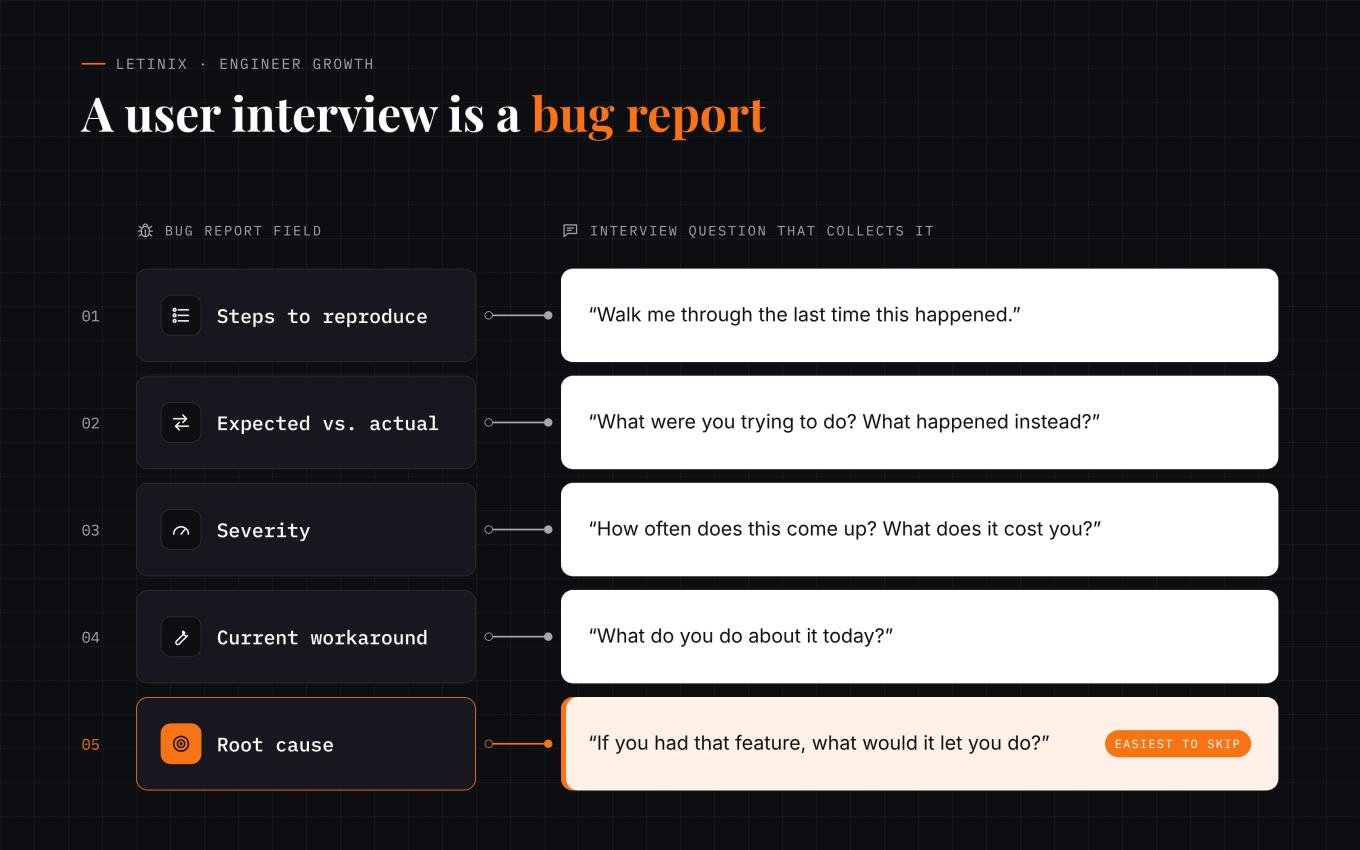
| Bug report field | Interview question that collects it |
|---|---|
| Steps to reproduce | "Walk me through the last time this happened." |
| Expected vs. actual result | "What were you trying to get done? What happened instead?" |
| Severity | "How often does this come up? What does it cost you when it does?" |
| Current workaround | "What do you do about it today?" |
| Root cause | "If you had that feature, what would it let you do?" |
The last row is the easiest one to skip. When a user names a feature, treat it like a stack trace pointing near the problem, not at it. Ask what the feature would let them do, then ask why that matters, until you reach something you can't simplify further.
Questions that get you the problem#
These are grouped by what each set helps you learn. Use them as a starting point and adapt the wording to your product and the person you are talking to.
Context: who you are talking to#
- "What's your role, and what does a normal week look like?" The same complaint means different things from a solo developer and from someone running a team of twenty.
- "Where does our product fit into that week?" This tells you whether you are a daily tool or something they open once a month.
Reproduction: what actually happened#
- "Tell me about the last time you did this." A specific past event is far more reliable than "usually I...". General answers describe how people think they work. A real story describes how they did work.
- "What did you do right before and right after?" The steps around your product often show the next problem worth solving.
- "Can you show me?" If you are on a call, ask them to share their screen and talk while they work. Watching beats listening.
Root cause: the problem behind the request#
- "What would that let you do?" Ask this every time a user suggests a feature.
- "Why haven't you solved this already?" If the answer is "it's not that big a deal", you have learned something important.
- "Can you say more about that?" You will use this one constantly. Vague words like "annoying", "slow" or "messy" need unpacking.
Severity: how much it matters#
- "Roughly how often does this happen?" Push for a number. "Sometimes" might mean once a year.
- "If you could only fix one of these, which one?" Ranking is more honest than asking whether each item is important, because everything sounds important on its own.
The idea of asking about past behavior and the problem behind a request, instead of collecting feature ideas, is explained in more depth in PostHog's Stop asking users what they want (Jina Yoon, November 2026), which includes examples from PostHog's own user interviews.
Questions to drop, and what to ask instead#
Some questions feel natural but steer the user toward polite or vague answers. PostHog's An engineer's guide to talking to users flags two of the most common: explaining your own idea, which biases what comes next, and asking "Would you use this?"
| Don't ask | Why it fails | Ask instead |
|---|---|---|
| "What features do you want?" | You get guesses, not problems | "What's the most frustrating part of doing this today?" |
| "Would you use this?" | Saying yes costs nothing, so people are polite | "When did you last need something like this? What did you do?" |
| "Do you like the product?" | Compliments feel good and teach you nothing | "What did you use it for this week?" |
| "Is this design good?" | Opinions before use are about the surface | Let them try it and watch where they get stuck |
| "Here's how our solution works..." | Explaining your idea biases every answer after it | Stay on their problem until the end of the call |
Worked example: from feature request to problem#
This is an illustrative example, not a real interview.
A user of an analytics dashboard says: "You need to add CSV export."
Taking that literally, you would build an export button. Instead you follow up:
- "What would you do with the CSV?" They paste a few numbers into a spreadsheet.
- "What happens to that spreadsheet?" It becomes a weekly summary they send to their manager every Monday.
- "How long does that take?" About 30 minutes, and they often forget a step.
- "Why haven't you automated it?" They didn't know they could, and it isn't their main job.
Now you know the real problem: a non-technical manager needs a reliable weekly summary, and producing it by hand wastes time and causes mistakes.
That opens several solutions, and choosing between them is your job: a scheduled email report, a shareable read-only dashboard link, a saved weekly view, or CSV export after all. Any of these might be right. The difference is that you are now choosing based on the problem, not just doing what the request said.
Keep users in the loop for the whole build#
User interviews are not a phase you finish before writing code. If users only appear at the start, you are back to building for your own taste from the second week onward.
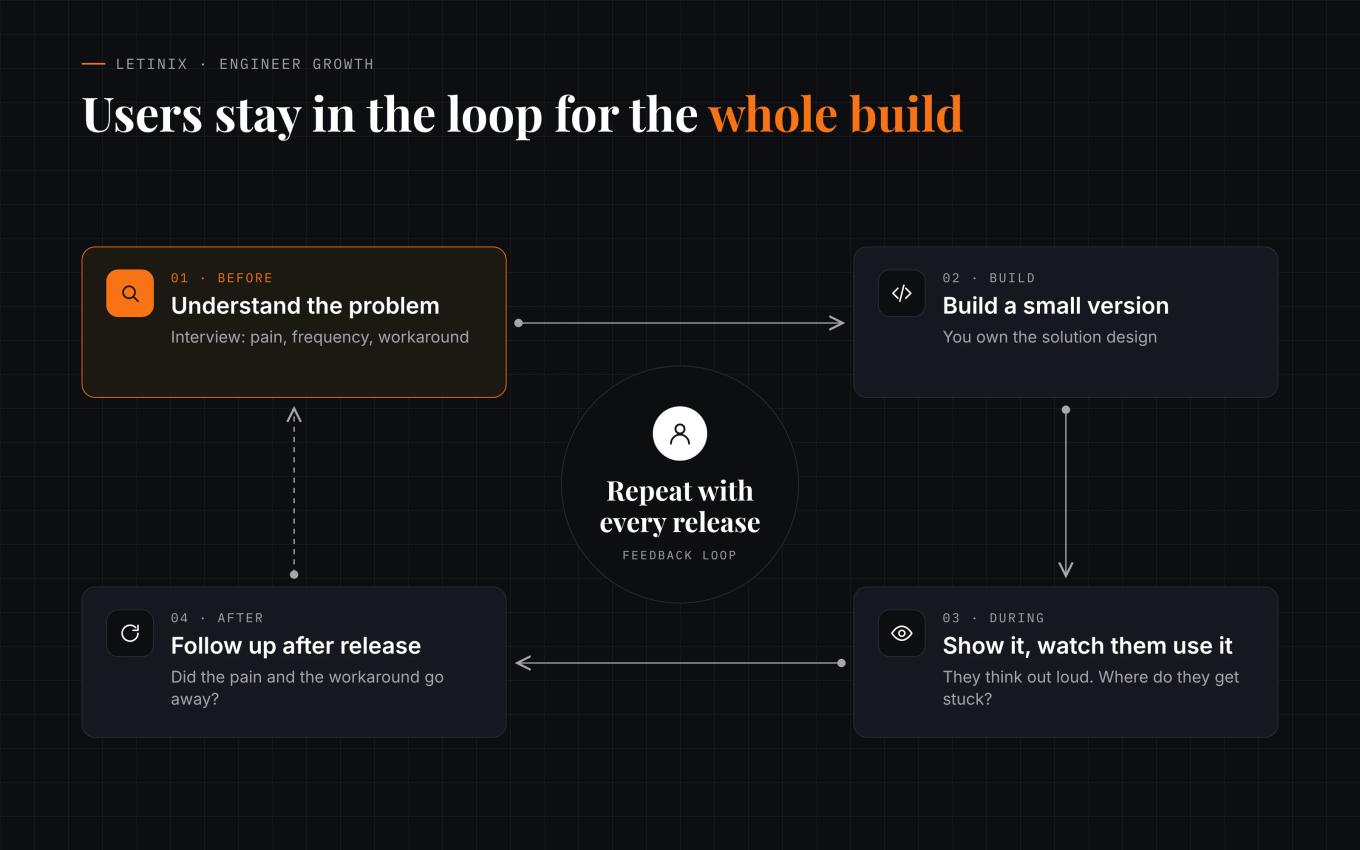
- Before building: interview to understand the problem, its severity and the current workaround.
- While building: show a rough version early. Ask users to try it and think out loud. Nielsen's article makes a related point: preference feedback is only meaningful after people have actually used a design.
- After release: follow up with the people you interviewed. Did the pain go away? Did they stop using the workaround? If not, you have a new bug report.
How to tell you're getting better at this#
There is no score for interview skill, but a few signals show your interviews are producing useful input:
- You can describe the user's problem in one or two sentences without naming a feature.
- Your notes contain specific stories with dates, steps and rough numbers, not adjectives.
- You know what the user does today instead, and roughly what it costs them.
- You can rank the problems you heard by what users said mattered most, not by what was easiest to build.
- After a call, you have changed your mind about something at least some of the time. If every interview confirms what you already believed, you may be leading the witness.
When this approach doesn't fit#
- Interviews don't measure scale. A handful of conversations shows you what a problem looks like, not how many users have it. Pair interviews with usage data where you have it.
- Interviews don't prove demand. As the PostHog example shows, people can describe a real problem and still not adopt a solution. Watching what they do after you ship is the stronger signal.
- Expert users sometimes do know the fix. If you build developer tools, your users are engineers, and their suggested solution may be exactly right. Still ask what it would let them do, so you understand the constraint you are designing for.
- Recording needs consent. Ask before recording a call, and follow your company's rules for handling customer data.
The short version: talk to users about their problems all the way through the build, and keep the solution for yourself.
References#
- Stop asking users what they want — Jina Yoon, PostHog (build mode newsletter), November 2026
- 6 mistakes we've made at PostHog (and what we learned) — Andy Vandervell, PostHog, June 2023
- First Rule of Usability? Don't Listen to Users — Jakob Nielsen, Nielsen Norman Group, 2001
- An engineer's guide to talking to users — PostHog

Software Engineer and Researcher, writing about AI, developer tooling and automation.