

Imagine a developer reaches an interview with a polished resume full of ownership, impact and leadership claims. The interviewer asks what the developer personally changed and how the result was measured. The answers become vague: some bullets describe team outcomes as individual work; others have no evidence behind them.
That is the wrong use of AI in a job search. A model can make weak evidence sound convincing, but it cannot give you experience. Use it to research roles, organise real examples, improve clarity and rehearse explanations. Keep every claim traceable to work you actually did.
Where AI genuinely helps#
AI is useful when it helps turn authentic experience into a clear application. Treat it as an editor and practice partner—not the author of your professional history.
1. Decode a job description#
Ask AI to separate a job description into categories instead of merely summarising it.
A useful analysis identifies:
- Core requirements: skills that appear central to the role's actual work.
- Supporting requirements: tools or practices that may help but are not the main job.
- Responsibilities: outcomes the role is expected to deliver.
- Evidence to prepare: projects or examples that could demonstrate each requirement.
- Unknowns: details the posting does not establish, such as team structure, deployment ownership or the exact level of production responsibility.
A job description is not a complete team specification. Do not turn ambiguous wording into confident claims about the employer.
2. Match your experience to the requirements#
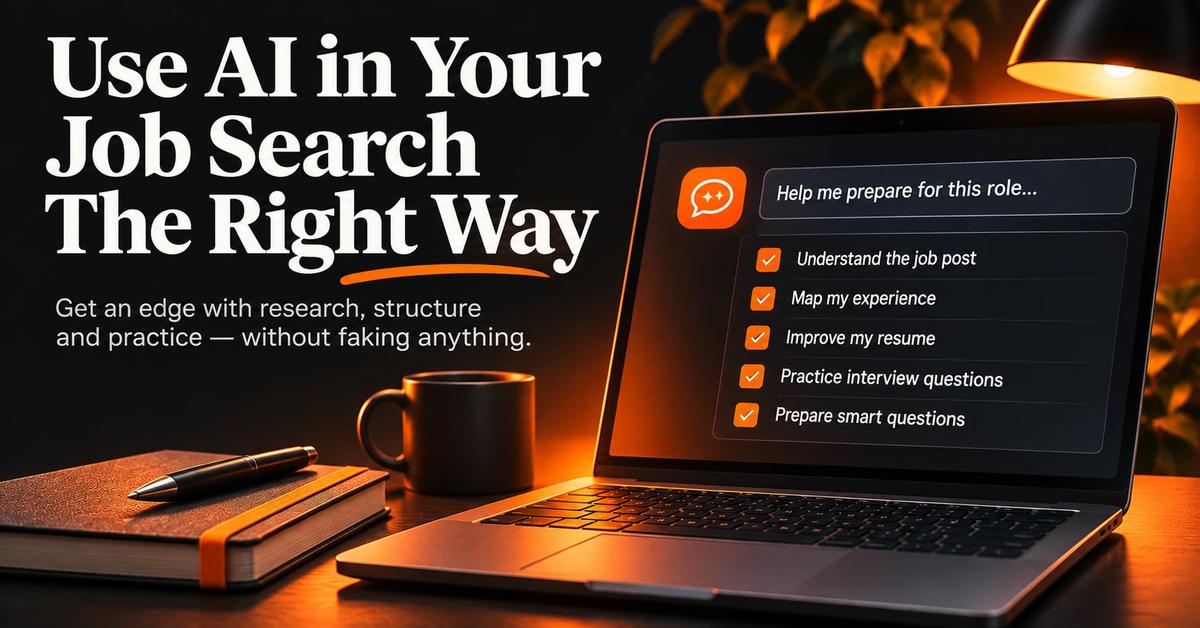
Give the model a redacted job description and a factual experience inventory. Ask for a requirement-to-evidence map: cite a supplied project, responsibility, decision or deliverable for each requirement, or mark it unsupported.
This reveals three useful groups:
- Strong match: you have direct evidence and can explain your contribution.
- Adjacent experience: you have related skills, but should describe the difference honestly.
- Gap: you do not currently have evidence for the requirement.
A gap is not automatically a reason to abandon an application. Decide whether adjacent experience is relevant, whether the skill is learnable, or whether the role is not a fit.
3. Turn duties into clear achievements#
AI can make resume bullets clearer by separating action, scope and result.
Supply the facts: your ownership, change, context and result. Ask for concise alternatives that preserve them. If you have no reliable metric, do not let the model insert one.
For example, “worked on frontend performance” is vague. If it is true, a more useful version might be: “Profiled the product listing page, identified repeated rendering work, and refactored the component state to reduce unnecessary updates.” This states an action and technical detail without inventing a measured business result. Only use it if it accurately describes your work.
4. Practise interview explanations#
Use AI as a practice interviewer. Ask it to question you about a real project, probe decisions and challenge unclear answers about architecture, debugging, trade-offs, testing or collaboration.
Give it the role description and a project you worked on. Ask one question at a time, answer in your own words, then request feedback on correctness and missing reasoning. Verify technical details independently.
5. Prepare better questions for the employer#
Use the job description and verified company material to draft questions about ownership, deployment, first-month expectations, incident handling and engineering decisions. Treat generated company details as leads, not facts. If a claim cannot be verified, turn it into an open question.
Where AI hurts your application#
The central risk is that AI makes unsupported content look finished.
- Invented metrics: a model may add percentages, latency improvements, revenue impact, user counts or delivery speed that were never measured. Remove them unless you can explain their source and calculation.
- Inflated ownership: “led,” “architected,” “owned” and “delivered” imply different levels of responsibility. Use the verb that matches your actual role. Do not convert a team result into an individual achievement.
- Generic cover letters: broad statements about passion, innovation and alignment rarely explain why your experience fits this specific role. Use a short, factual note tied to one or two real requirements—or do not write a cover letter if it adds nothing.
- Same-sounding applications: repeated AI phrasing can flatten your technical voice. Keep the words you would naturally use to explain the work to another engineer.
- Outdated company facts: model knowledge may be incomplete or stale. Verify product names, leadership, strategy, team structure, office arrangements and role details before referencing them.
- Interview dependence: memorising a generated answer can fail as soon as an interviewer changes the question. Practise the underlying reasoning, not a script.
A practical workflow: from job post to offer#
Use AI to clarify decisions, but keep source material and final judgment under your control.
- Choose a role worth pursuing. Read the listing yourself. Confirm role, location, seniority, skills and application instructions from the current employer page.
- Extract the requirements. Ask AI to group responsibilities, requirements, preferences and ambiguities. Correct its interpretation.
- Build an evidence map. Attach a real example to each important requirement. Label matches strong, adjacent or missing; never fill gaps with invented experience.
- Tailor the resume. Select relevant evidence and rewrite for clarity, not keyword repetition. Preserve accurate dates, titles, technologies, scope and ownership. Check that you can explain every bullet.
- Prepare the application message. If requested, connect one role requirement to your experience. Remove generic praise and unsupported claims.
- Research the employer. Use current official sources for company facts; use AI to organise verified notes and draft questions.
- Practise the interview. Rehearse project walkthroughs, decisions, debugging and trade-offs. Ask follow-ups, revise weak explanations and practise without reading a generated answer.
- Review after each conversation. Record questions, unclear explanations and topics to verify. Turn those notes into a focused practice plan; do not infer what the interviewer thought.
The workflow does not guarantee an interview or offer. It makes the work you submit more relevant and the answers you give easier to defend.
Five prompts to start with#
Replace bracketed sections with information you are comfortable sharing. Keep the facts in your own notes as the source of truth.
1. Analyse a job post
Break this job description into core requirements, preferred skills, responsibilities and unknowns. Do not infer requirements that are not stated. Return a concise checklist: [paste redacted job description].
2. Map experience to requirements
Compare this job description with my experience notes. For each requirement, cite the exact evidence from my notes and label it strong, adjacent or missing. Do not invent examples: [job description] [experience notes].
3. Improve a resume bullet
Rewrite this bullet for clarity and relevance. Preserve the exact scope, ownership and result. Do not add metrics, technologies or impact. If information is missing, ask me: [bullet and context].
4. Run a project interview
Act as a technical interviewer for [role]. Ask one question at a time about this project. Probe my decisions and trade-offs. After my answer, identify vague claims and ask for evidence. Do not supply an answer before I attempt one: [project summary].
5. Prepare employer questions
Based only on this job description and the verified company notes below, suggest thoughtful questions about team ownership, engineering practices and role expectations. Separate confirmed facts from assumptions: [job description] [verified notes].
Do and don't#
| Do | Don't |
|---|---|
| Use AI to organise real project evidence. | Ask it to create achievements you cannot substantiate. |
| Keep a source note for every metric and result. | Accept a plausible-looking number because it sounds professional. |
| Tailor the resume to relevant requirements. | Stuff the document with every keyword in the posting. |
| Practise explaining decisions in your own words. | Memorise generated answers as if they were your experience. |
| Verify current company information. | Repeat unverified product, leadership or culture claims. |
| Review and edit the final application yourself. | Submit a draft you have not checked line by line. |
Privacy and honesty: rules worth keeping#
Job-search notes contain personal information. Check the AI service’s current data controls and the terms for your account or organisation. A prompt is not automatically private because it is not publicly visible.
As a practical baseline, do not paste:
- government identification numbers, passport details, home address or personal phone number when they are not needed;
- passwords, API keys, access tokens, private repository credentials or confidential source code;
- internal customer information, unreleased product plans, private incident details or proprietary project documents;
- another person's personal information, interview feedback or confidential hiring material;
- private recruiter or employer correspondence unless you have permission and have removed unnecessary identifying details.
Use placeholders such as [Company], [Project] and [Metric] when identities are unnecessary. Remove identifiers before sharing notes. Follow your employer's data policy when using its AI account.
Apply this verification test to every output:
- Can I prove it? Keep a source for dates, metrics, project scope and outcomes.
- Can I explain it? Be ready to describe what you personally did, why you chose the approach and what trade-offs you considered.
- Is it current? Verify company and role facts against current, authoritative material.
- Is it mine to share? Remove confidential information and respect employer, client and former-team obligations.
- Does it sound like me? Edit generated prose until it reflects how you actually communicate.
If a bullet fails any of these checks, revise it or remove it. A smaller set of defensible claims is better than a larger set of polished claims that collapse under follow-up questions.
What to do next#
Use the AI Prompt Pack for Job Seekers as a starting point for structured job-search tasks. For a more focused professional profile and developer-oriented LinkedIn content, see the LinkedIn Prompt Pack for Developers.
The boundary is straightforward: let AI improve the research, structure and practice around your experience. Keep the experience itself accurate, private where necessary, and yours to explain.

Software Engineer and Researcher, writing about AI, developer tooling and automation.